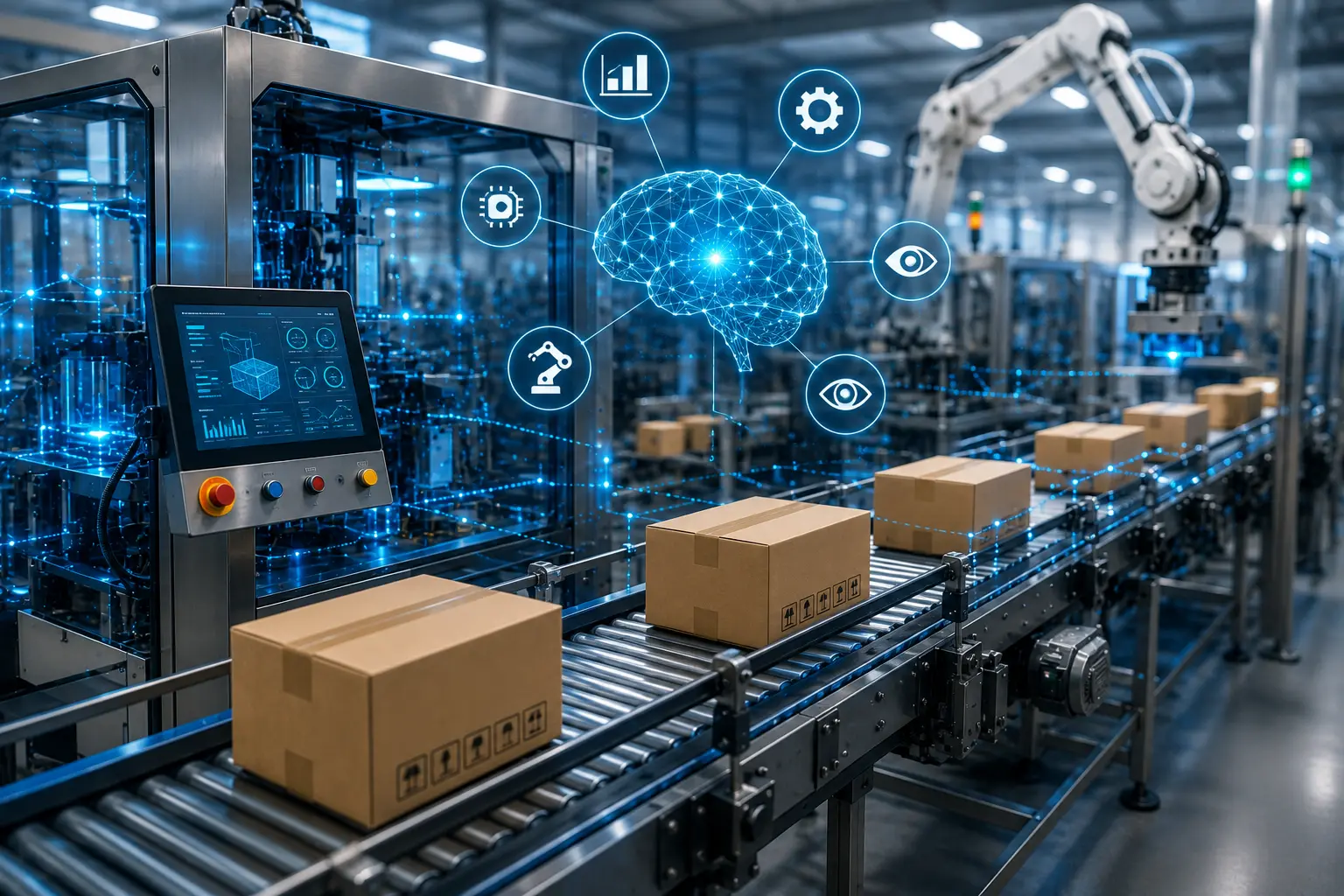
Artificial intelligence is rapidly changing the future of manufacturing, and packaging operations are becoming one of its most important areas of transformation. As production demands grow and industries move toward smarter factories, packaging lines are evolving from machine driven systems into intelligent, data driven environments.
AI is helping manufacturers improve efficiency, reduce downtime, increase accuracy, and make faster operational decisions. From predictive maintenance to automated quality control, AI powered systems are reshaping how packaging lines operate across industries such as FMCG, food, pharmaceuticals, chemicals, and industrial manufacturing.
What AI Means in Packaging Operations
Artificial intelligence in packaging refers to the use of machine learning, smart sensors, data analytics, and intelligent automation systems to improve packaging performance.
Unlike traditional automation, AI systems can analyze large amounts of production data, identify patterns, and make decisions based on real time conditions. This allows packaging lines to become more adaptive and efficient over time.
AI driven systems can:
- Predict machine failures before they happen
- Optimize machine speed automatically
- Detect packaging defects instantly
- Improve line synchronization
- Reduce material wastage
- Support faster production planning
The goal is to create smarter packaging environments that continuously improve performance.
Predictive Maintenance and Reduced Downtime
One of the biggest ways AI will impact packaging lines is through predictive maintenance. Traditional maintenance relies on scheduled servicing or reactive repairs after breakdowns occur. AI changes this approach completely.
Smart sensors monitor machine conditions such as vibration, temperature, pressure, and motor performance in real time. AI systems analyze this data and identify warning signs before failures happen.
For example, if a motor begins operating outside its normal pattern, the system can alert maintenance teams before the machine stops working. This reduces unexpected downtime and helps manufacturers avoid costly production interruptions.
Predictive maintenance also extends machine lifespan by preventing excessive wear and damage.
AI Powered Quality Control
Packaging quality is critical in industries such as pharmaceuticals, food, and FMCG. Even small defects can lead to customer complaints, product recalls, or compliance issues.
AI powered vision systems are transforming quality inspection. High speed cameras and machine learning software can detect incorrect labels, seal defects, damaged packaging, incorrect product placement or missing components.
Unlike manual inspection, AI systems work continuously and improve accuracy over time by learning from production data.
This helps manufacturers reduce product rejection rates while maintaining consistent packaging quality.
Smarter Machine Synchronization
Modern packaging lines involve multiple connected machines such as fillers, sealers, cartonators, and palletizers. If one machine slows down or stops, the entire line can become inefficient.
AI improves synchronization by analyzing production flow across the line and adjusting machine speeds automatically. Instead of relying on fixed settings, AI systems adapt in real time to maintain balanced operations.
This reduces bottlenecks and improves overall line efficiency.
Faster SKU Changeovers
Manufacturers handling multiple products and packaging formats often face delays during SKU changeovers. AI can simplify this process by automatically adjusting machine settings based on stored production recipes.
Instead of manually configuring each machine, operators can select a product profile and allow AI systems to optimize settings automatically.
This reduces setup time and minimizes operator errors.
Improved Production Planning
AI helps manufacturers make smarter production decisions by analyzing operational data and identifying trends.
AI systems can:
- Forecast production demand
- Identify inefficiencies
- Optimize scheduling
- Predict material requirements
- Reduce idle machine time
This allows manufacturers to improve resource planning and reduce operational waste.
Reduction in Material Waste
Packaging material costs are a major concern for manufacturers. AI systems help reduce waste by monitoring filling accuracy, sealing conditions, and material usage in real time.
If the system detects overfilling, improper sealing, or unnecessary film usage, it automatically adjusts machine parameters to improve efficiency.
This not only lowers costs but also supports sustainable manufacturing practices.
AI and Robotics in Packaging
AI combined with robotics is creating more intelligent packaging lines. Robotic systems powered by AI can:
- Identify and sort products
- Handle variable packaging formats
- Optimize palletizing patterns
- Adapt to changing production conditions
These systems improve flexibility and allow packaging lines to handle greater product variation with minimal manual intervention.
Real Time Data Visibility
AI driven dashboards provide manufacturers with live operational insights. Plant managers can monitor:
- Machine performance
- Downtime trends
- Production efficiency
- Error frequency
- Energy consumption
This visibility helps businesses respond faster to issues and continuously improve packaging operations.
Challenges of AI Adoption
Despite its benefits, implementing AI in packaging operations comes with challenges.
Initial Investment
AI systems require investment in sensors, software, connectivity, and training.
Data Integration
Older machines may not easily integrate with AI platforms without retrofitting or upgrades.
Workforce Adaptation
Operators and maintenance teams need training to work effectively with AI driven systems.
However, as technology becomes more accessible, adoption barriers are gradually decreasing.
Future of AI in Packaging Lines
The future of packaging will become increasingly intelligent and autonomous. AI systems will continue learning from operational data and making packaging lines more adaptive.
Future developments may include:
- Self optimizing packaging lines
- Fully automated quality control
- AI driven production scheduling
- Autonomous maintenance systems
Manufacturers that adopt AI early will gain advantages in productivity, scalability, and operational reliability.
Final Thoughts
AI is transforming packaging lines from traditional machine based systems into smart, connected, and data driven operations. By improving maintenance, quality control, synchronization, and production planning, AI helps manufacturers achieve greater efficiency and operational stability.
As industries continue moving toward smart manufacturing, AI will play a central role in shaping the future of packaging operations. Businesses that invest in intelligent packaging technologies today will be better prepared for tomorrow’s competitive manufacturing environment.